

Class 8 Mathematics Chapter 4 Quadrilaterals (New Course)

  • Home
  • Class 8 Mathematics Chapter 4 Quadrilaterals (New Course)
ptitle-particle2
ptitle-particle1

Report a question

You cannot submit an empty report. Please add some details.

Class 8 Mathematics Chapter 4 Quadrilaterals (New Course)

This quiz on Class 8 Mathematics Chapter 4: Quadrilaterals is designed to test students’ understanding of the properties, types, and theorems related to quadrilaterals. It covers key concepts such as the sum of interior angles, conditions for special quadrilaterals like parallelograms, rhombuses, rectangles, squares, and trapeziums, as well as the relationships between their sides, angles, and diagonals. Through problem-based and reasoning questions, the quiz encourages learners to apply geometrical properties, analyze figures, and solve application-based problems. It aims to strengthen logical thinking, enhance visualization skills, and build a strong foundation for higher-level geometry.

1 / 100

Topic/Sub Topic: Rectangles and Squares

1. A rectangle and a square have the same perimeter. If the rectangle has dimensions \$$10$ cm by \$$6$ cm, what is the ratio of the length of the diagonal of the square to the diagonal of the rectangle?

2 / 100

Topic/Sub Topic: Rectangles and Squares

2. (A) The diagonals of a square are equal in length and bisect each other at 90°.
(R) A square is a quadrilateral with all sides equal and all angles equal to 90°.

3 / 100

Topic/Sub Topic: Rectangle: Definition, properties (opposite sides equal, all angles 90°).

3. Consider the following statements about quadrilaterals:
I. If all angles of a quadrilateral are $90^\circ$, then it must be a rectangle.
II. If the diagonals of a quadrilateral are equal and bisect each other at $90^\circ$, then it must be a square.
Which of these statements is/are correct?

4 / 100

Topic/Sub Topic: Rectangle: Definition, properties (opposite sides equal, all angles 90°).

4. The diagonals of a quadrilateral bisect each other at 90° and are equal in length. What is the shape of the quadrilateral?

5 / 100

Topic/Sub Topic: Square: Special type of rectangle (all sides equal).

5. (A) The diagonals of a square bisect each other at $90^\circ$.
(R) The diagonals of a square are equal in length and bisect the angles.

6 / 100

Topic/Sub Topic: Square: Special type of rectangle (all sides equal).

6. In a square $ABCD$, the diagonals intersect at point $O$. If the measure of $\angle AOB$ is $90^\circ$, what is the measure of $\angle OAB$?

7 / 100

Topic/Sub Topic: Properties of Rectangles:

7. If the diagonals of a quadrilateral are equal and bisect each other, what can you conclude about the quadrilateral?

8 / 100

Topic/Sub Topic: Properties of Rectangles:

8. What makes a square different from a rectangle?

9 / 100

Topic/Sub Topic: Diagonals equal and bisect each other.

9. Which property is common to both a square and a rhombus regarding their diagonals?

10 / 100

Topic/Sub Topic: Diagonals equal and bisect each other.

10. The diagonals of a rectangle ABCD intersect at point O. If $AO = 3x + 1$ and $BO = 5x – 7$, what is the length of diagonal AC?

11 / 100

Topic/Sub Topic: Diagonals equal and bisect each other.

11. If the diagonals of a rectangle intersect at point $O$, which of the following statements is true?

12 / 100

Topic/Sub Topic: Diagonals equal and bisect each other.

12. (A) The diagonals of a rectangle always intersect at their midpoints.
(R) A rectangle is a type of parallelogram where the diagonals bisect each other.

13 / 100

Topic/Sub Topic: Angles between diagonals.

13. What is the measure of each angle formed at the intersection of the diagonals of a rectangle?

14 / 100

Topic/Sub Topic: Angles between diagonals.

14. In a rectangle, the angle between its diagonals is $50^\circ$. What are the other three angles formed by the diagonals?

15 / 100

Topic/Sub Topic: Angles between diagonals.

15. (A) If the diagonals of a quadrilateral bisect each other at $90^\circ$, then the quadrilateral must be a rhombus or square.
(R) A quadrilateral with diagonals bisecting each other at $90^\circ$ has all sides equal.

16 / 100

Topic/Sub Topic: Angles between diagonals.

16. In a square, if one angle between the diagonals is given as $x$, what are the measures of the remaining three angles?

17 / 100

Topic/Sub Topic: Construction and reasoning

17. (A) The diagonals of a rectangle are equal in length.
(R) The diagonals of a rectangle bisect each other.

18 / 100

Topic/Sub Topic: Construction and reasoning

18. What is the angle between the diagonals of a square?

19 / 100

Topic/Sub Topic: Construction and reasoning

19. (A) If the diagonals of a quadrilateral are equal in length and bisect each other at 90°, then the quadrilateral must be a square.
(R) A square has diagonals that are equal in length, bisect each other, and intersect at right angles.

20 / 100

Topic/Sub Topic: Construction and reasoning

20. A rectangle ABCD has diagonals AC and BD intersecting at O. If AO = 5 cm, what is the length of BD?

21 / 100

Topic/Sub Topic: A Carpenter’s Problem

21. (A) A quadrilateral is a rectangle if its diagonals are equal in length and bisect each other.
(R) The diagonals of a rectangle are equal and bisect each other at $90^\circ$.

22 / 100

Topic/Sub Topic: A Carpenter’s Problem

22. (A) If two equal-length strips of wood are joined at their midpoints and the angle between them is $90^\circ$, then the quadrilateral formed by connecting their endpoints will be a square.
(R) In a quadrilateral, if the diagonals are equal in length, bisect each other, and intersect at right angles, then it must be a square.

23 / 100

Topic/Sub Topic: A Carpenter’s Problem

23. (A) A quadrilateral with diagonals equal in length and bisecting each other is a rectangle.
(R) In a rectangle, the diagonals are equal and bisect each other.

24 / 100

Topic/Sub Topic: A Carpenter’s Problem

24. A carpenter wants to construct a square using two wooden strips as diagonals. If one diagonal is 8 cm long, what must be the length of the other diagonal?

25 / 100

Topic/Sub Topic: The Process of Finding Properties

25. In a quadrilateral, three angles measure $80^\circ$, $95^\circ$, and $70^\circ$. What is the measure of the fourth angle?

26 / 100

Topic/Sub Topic: The Process of Finding Properties

26. Which of the following statements is NOT true for a square?

27 / 100

Topic/Sub Topic: The Process of Finding Properties

27. You have two sticks of length 10 cm each. How would you construct a right angle using these sticks and a thread, without any measuring tool?

28 / 100

Topic/Sub Topic: The Process of Finding Properties

28. (A) The diagonals of a square bisect each other at right angles.
(R) A square is a special type of rectangle where all sides are equal and all angles are $90^\circ$.

29 / 100

Topic/Sub Topic: A Special Rectangle

29. Which statement correctly describes the relationship between squares and rectangles?

30 / 100

Topic/Sub Topic: A Special Rectangle

30. What is true about the diagonals of a rectangle?

31 / 100

Topic/Sub Topic: A Special Rectangle

31. (A) Every square is a rectangle.
(R) In a square, all angles are $90^\circ$, and opposite sides are equal and parallel.

32 / 100

Topic/Sub Topic: A Special Rectangle

32. What is the measure of each angle in a rectangle?

33 / 100

Topic/Sub Topic: Angles in a Quadrilateral

33. In quadrilateral ABCD, angle A is twice angle B, angle C is $20^\circ$ more than angle B, and angle D is $40^\circ$ less than angle B. What is the measure of angle B?

34 / 100

Topic/Sub Topic: Angles in a Quadrilateral

34. In a parallelogram ABCD, if $\angle A = 3x + 10^\circ$ and $\angle C = 5x – 30^\circ$, what is the value of $x$?

35 / 100

Topic/Sub Topic: Angles in a Quadrilateral

35. In parallelogram PQRS, if $\angle P = 60^\circ$, what is the measure of its adjacent angle $\angle Q$?

36 / 100

Topic/Sub Topic: Angles in a Quadrilateral

36. In a quadrilateral where the diagonals bisect each other, which of the following must be true?

37 / 100

Topic/Sub Topic: Sum of angles: The sum of angles in any quadrilateral is 360°.

37. If one diagonal of a quadrilateral divides it into two triangles with angles $40°$, $60°$, $80°$ and $50°$, $70°$, $60°$ respectively, what is the sum of the interior angles of the quadrilateral?

38 / 100

Topic/Sub Topic: Sum of angles: The sum of angles in any quadrilateral is 360°.

38. (A) If three angles of a quadrilateral measure 80°, 100° and 90°, then the fourth angle must be 90°.
(R) The sum of all interior angles in any quadrilateral is always 360°.

39 / 100

Topic/Sub Topic: Sum of angles: The sum of angles in any quadrilateral is 360°.

39. A quadrilateral has three angles measuring 80°, 100°, and 70° respectively. What is the measure of the fourth angle?

40 / 100

Topic/Sub Topic: Sum of angles: The sum of angles in any quadrilateral is 360°.

40. Which of the following quadrilaterals has all four angles equal to $90^\circ$ and opposite sides equal and parallel?

41 / 100

Topic/Sub Topic: Construction of quadrilaterals with three right angles and a non-right fourth angle.

41. You are asked to construct a quadrilateral ABCD where $\angle A = 80^\circ$, $\angle B = 90^\circ$, $\angle C = 90^\circ$, and side AB = 5 cm. What would be the measure of $\angle D$ if the quadrilateral exists?

42 / 100

Topic/Sub Topic: Construction of quadrilaterals with three right angles and a non-right fourth angle.

42. A quadrilateral PQRS has three angles equal to $90^\circ$ each. If its diagonals PR and QS intersect at point O such that angle POQ is $60^\circ$, what can be concluded about the fourth angle of the quadrilateral?

43 / 100

Topic/Sub Topic: Construction of quadrilaterals with three right angles and a non-right fourth angle.

43. (A) It is not possible to construct a quadrilateral with three angles equal to $90^\circ$ and the fourth angle not equal to $90^\circ$.
(R) The sum of all angles in any quadrilateral is $360^\circ$.

44 / 100

Topic/Sub Topic: Construction of quadrilaterals with three right angles and a non-right fourth angle.

44. Which of the following statements is true about constructing a quadrilateral with three right angles?

45 / 100

Topic/Sub Topic: More Quadrilaterals with Parallel Opposite Sides

45. Which of the following statements is true for all rhombuses but not necessarily for all rectangles?

46 / 100

Topic/Sub Topic: More Quadrilaterals with Parallel Opposite Sides

46. In quadrilateral $PQRS$, $\angle P = 80^\circ$, $\angle Q = 95^\circ$, and $\angle R = 70^\circ$. What is the measure of $\angle S$?

47 / 100

Topic/Sub Topic: More Quadrilaterals with Parallel Opposite Sides

47. In a parallelogram $ABCD$ if $\angle A = 60^\circ$, what is the measure of $\angle B$?

48 / 100

Topic/Sub Topic: More Quadrilaterals with Parallel Opposite Sides

48. The diagonals of a rhombus intersect at $O$. If one diagonal is $12$ cm and the other is $16$ cm, what is the side length of the rhombus?

49 / 100

Topic/Sub Topic: Parallelograms: Definition and properties (opposite sides parallel and equal).

49. In a parallelogram, if one of the adjacent angles measures $60°$, what is the measure of its adjacent angle?

50 / 100

Topic/Sub Topic: Parallelograms: Definition and properties (opposite sides parallel and equal).

50. In parallelogram ABCD, if $AB = 6\,cm$ and $AD = 4\,cm$, which of the following pairs of triangles are congruent?

51 / 100

Topic/Sub Topic: Parallelograms: Definition and properties (opposite sides parallel and equal).

51. If in a parallelogram $ABCD$, side $AB = 5\,cm$, what is the length of side $CD$?

52 / 100

Topic/Sub Topic: Parallelograms: Definition and properties (opposite sides parallel and equal).

52. (A) In a parallelogram, the sum of the squares of the lengths of its diagonals is equal to twice the sum of the squares of its adjacent sides.
(R) The diagonals of a parallelogram bisect each other and satisfy the relation: $d_1^2 + d_2^2 = 2(a^2 + b^2)$, where $d_1$ and $d_2$ are the lengths of the diagonals, and $a$, $b$ are the lengths of adjacent sides.

53 / 100

Topic/Sub Topic: Rectangles as a type of parallelogram.

53. (A) A rectangle is a parallelogram.
(R) A rectangle has opposite sides parallel and equal.

54 / 100

Topic/Sub Topic: Rectangles as a type of parallelogram.

54. In rectangle $PQRS$, the diagonals intersect at point $O$. If $\angle POS = 70°$, what is the measure of $\angle OSR$?

55 / 100

Topic/Sub Topic: Rectangles as a type of parallelogram.

55. Which statement correctly describes the relationship between rectangles and parallelograms?

56 / 100

Topic/Sub Topic: Rectangles as a type of parallelogram.

56. (A) A rectangle is a special type of parallelogram.
(R) A rectangle has both pairs of opposite sides parallel and equal, and its diagonals bisect each other.

57 / 100

Topic/Sub Topic: Venn Diagram: Relationship between rectangles, rhombuses, squares, and parallelograms.

57. In a rhombus ABCD, if $\angle A = 60^\circ$, what is the measure of $\angle B$?

58 / 100

Topic/Sub Topic: Venn Diagram: Relationship between rectangles, rhombuses, squares, and parallelograms.

58. If a quadrilateral has diagonals that are equal in length and bisect each other at $90^\circ$, what must it be?

59 / 100

Topic/Sub Topic: Venn Diagram: Relationship between rectangles, rhombuses, squares, and parallelograms.

59. Which statement is true about a rectangle?

60 / 100

Topic/Sub Topic: Venn Diagram: Relationship between rectangles, rhombuses, squares, and parallelograms.

60. Which of the following statements is true about the relationship between a rhombus and a square?

61 / 100

Topic/Sub Topic: Quadrilaterals with Equal Side Lengths

61. How does a square differ from a general rhombus?

62 / 100

Topic/Sub Topic: Quadrilaterals with Equal Side Lengths

62. Which property is true for the diagonals of a rhombus?

63 / 100

Topic/Sub Topic: Quadrilaterals with Equal Side Lengths

63. Which of the following is a property of a rhombus?

64 / 100

Topic/Sub Topic: Quadrilaterals with Equal Side Lengths

64. In a rhombus, one of the angles measures $50^\circ$. What is the measure of its adjacent angle?

65 / 100

Topic/Sub Topic: Rhombus: A quadrilateral with equal sides.

65. Consider rhombus $PQRS$. If $\angle PQR = 110^\circ$, then what is the sum of $\angle QPS$ and $\angle RSP$?

66 / 100

Topic/Sub Topic: Rhombus: A quadrilateral with equal sides.

66. One diagonal of a rhombus is 16 cm, and the side length is 10 cm. What is the perimeter of the rhombus?

67 / 100

Topic/Sub Topic: Rhombus: A quadrilateral with equal sides.

67. (A) All sides of a rhombus are equal.
(R) A quadrilateral with all sides equal is defined as a rhombus.

68 / 100

Topic/Sub Topic: Rhombus: A quadrilateral with equal sides.

68. (A) The diagonals of a rhombus bisect each other at right angles.
(R) In a rhombus, the adjacent angles add up to $180^\circ$ and the opposite angles are equal.

69 / 100

Topic/Sub Topic: Properties of Rhombus: Opposite angles are equal, diagonals bisect each other at 90°.

69. What is the angle at which the diagonals of a rhombus bisect each other?

70 / 100

Topic/Sub Topic: Properties of Rhombus: Opposite angles are equal, diagonals bisect each other at 90°.

70. (A) The diagonals of a rhombus bisect each other at $90^\circ$.
(R) A rhombus is a quadrilateral with all sides equal in length.

71 / 100

Topic/Sub Topic: Properties of Rhombus: Opposite angles are equal, diagonals bisect each other at 90°.

71. In rhombus $PQRS$, the diagonals intersect at point $O$. If $\angle QPO = 30^\circ$ and $\angle ROQ = x^\circ$, what is the value of $x$?

72 / 100

Topic/Sub Topic: Properties of Rhombus: Opposite angles are equal, diagonals bisect each other at 90°.

72. Which of the following statements about the diagonals of a rhombus is true?

73 / 100

Topic/Sub Topic: Playing with Quadrilaterals

73. If the diagonals of a square are extended equally on both sides by 2 cm, what type of quadrilateral is formed by joining the new endpoints?

74 / 100

Topic/Sub Topic: Playing with Quadrilaterals

74. If you extend one of the diagonals on both sides by 2 cm in the previous setup, what quadrilateral will you get now?

75 / 100

Topic/Sub Topic: Playing with Quadrilaterals

75. (A) A quadrilateral with diagonals intersecting at right angles and equal in length is a square.
(R) A quadrilateral with all sides equal and diagonals equal in length must be a rectangle.

76 / 100

Topic/Sub Topic: Playing with Quadrilaterals

76. A quadrilateral has diagonals that are perpendicular bisectors of each other but not equal in length. Which type of quadrilateral is this?

77 / 100

Topic/Sub Topic: Geoboard activity: Exploring quadrilaterals using rubber bands or dot grids.

77. (A) A quadrilateral formed on a geoboard with diagonals of equal length that bisect each other at $90^\circ$ must be a square.
(R) In a quadrilateral, if the diagonals are equal in length, bisect each other, and intersect at $90^\circ$, then all its sides are equal and all angles are $90^\circ$.

78 / 100

Topic/Sub Topic: Geoboard activity: Exploring quadrilaterals using rubber bands or dot grids.

78. (A) The quadrilateral formed by joining two identical equilateral triangles side-by-side is a rhombus.
(R) A rhombus has all sides equal and opposite sides parallel.

79 / 100

Topic/Sub Topic: Geoboard activity: Exploring quadrilaterals using rubber bands or dot grids.

79. (A) A quadrilateral formed by two perpendicular diagonals of equal length is a rectangle.
(R) Diagonals of a rectangle are equal in length and bisect each other at $90^\circ$.

80 / 100

Topic/Sub Topic: Geoboard activity: Exploring quadrilaterals using rubber bands or dot grids.

80. If one diagonal of a square on a geoboard is extended equally on both sides, what shape results?

81 / 100

Topic/Sub Topic: Constructing quadrilaterals by joining triangles of equal sides.

81. If two identical scalene triangles with sides 6 cm, 9 cm, and 12 cm are joined along their 6 cm sides, which quadrilateral is formed?

82 / 100

Topic/Sub Topic: Constructing quadrilaterals by joining triangles of equal sides.

82. (A) Joining two equilateral triangles along one side will always result in a rhombus.
(R) A rhombus has all sides equal and opposite angles equal.

83 / 100

Topic/Sub Topic: Constructing quadrilaterals by joining triangles of equal sides.

83. If two equilateral triangles, each with side length 8 cm, are joined along a common side, what type of quadrilateral is formed?

84 / 100

Topic/Sub Topic: Constructing quadrilaterals by joining triangles of equal sides.

84. In a kite ABCD where AB = BC and CD = DA, what is the relationship between the diagonals AC and BD?

85 / 100

Topic/Sub Topic: Kite and Trapezium

85. (A) The diagonals of a kite are perpendicular to each other.
(R) A kite has two distinct pairs of adjacent sides equal.

86 / 100

Topic/Sub Topic: Kite and Trapezium

86. In trapezium $PQRS$ with $PQ \parallel SR$, if $\angle P = 60^\circ$, what is $\angle S$?

87 / 100

Topic/Sub Topic: Kite and Trapezium

87. In a kite $ABCD$ with $AB = BC$ and $CD = DA$, if $\angle ABC = 120^\circ$, what is the measure of $\angle ADC$?

88 / 100

Topic/Sub Topic: Kite and Trapezium

88. In an isosceles trapezium $PQRS$ with $PQ \parallel SR$ and $PS = QR$, if $\angle P = 100^\circ$, what is the measure of $\angle S$?

89 / 100

Topic/Sub Topic: Kite: A quadrilateral with two pairs of adjacent sides equal.

89. (A) The diagonals of a kite bisect each other at right angles.
(R) A kite has two pairs of adjacent sides equal.

90 / 100

Topic/Sub Topic: Kite: A quadrilateral with two pairs of adjacent sides equal.

90. Which statement is true about kites and rhombuses?

91 / 100

Topic/Sub Topic: Kite: A quadrilateral with two pairs of adjacent sides equal.

91. If $\Delta AOB \cong \Delta COB$ in kite ABCD, what is the relationship between the sides and angles of these triangles?

92 / 100

Topic/Sub Topic: Kite: A quadrilateral with two pairs of adjacent sides equal.

92. Kite $PQRS$ has diagonals $PR$ and $QS$ intersecting at point $O$. Given that $PO = 5$ cm and $RO = 5$ cm, if the area of the kite is 50 cm 2, what is the length of diagonal $QS$?

93 / 100

Topic/Sub Topic: Trapezium: A quadrilateral with at least one pair of parallel sides.

93. In an isosceles trapezium $UVWX$ with $UV \parallel WX$ and $UX = VW$, if $\angle U = 70^\circ$, what is the measure of $\angle V$?

94 / 100

Topic/Sub Topic: Trapezium: A quadrilateral with at least one pair of parallel sides.

94. The measures of three angles of a trapezium are $105^\circ$, $135^\circ$, and $100^\circ$. What is the measure of the fourth angle?

95 / 100

Topic/Sub Topic: Trapezium: A quadrilateral with at least one pair of parallel sides.

95. (A) In an isosceles trapezium UVWX where UV$\parallel$XW, $\angle$U = $\angle$V.

(R) The non-parallel sides UX and VW are equal in length in an isosceles trapezium.

96 / 100

Topic/Sub Topic: Trapezium: A quadrilateral with at least one pair of parallel sides.

96. A kite PQRS has PQ = QR = 5 cm and PS = SR = 7 cm. If diagonal PR = 8 cm, what is the length of QS?

97 / 100

Topic/Sub Topic: Properties of Kite and Trapezium: Diagonals and angle relationships.

97. In a kite ABCD, diagonal BD bisects $\angle ABC$ and $\angle ADC$. If $\angle ABC = 80^\circ$, what is the measure of $\angle ABD$?

98 / 100

Topic/Sub Topic: Properties of Kite and Trapezium: Diagonals and angle relationships.

98. An isosceles trapezium has two angles opposite to the equal sides as $65^\circ$ each. What is the measure of each of the other two angles?

99 / 100

Topic/Sub Topic: Properties of Kite and Trapezium: Diagonals and angle relationships.

99. In kite $ABCD$, if diagonal $BD$ is perpendicular to diagonal $AC$ at point $O$, and $AO = 4\,cm$, find the length of $OC$.

100 / 100

Topic/Sub Topic: Properties of Kite and Trapezium: Diagonals and angle relationships.

100. In an isosceles trapezium $PQRS$ with $PQ \parallel SR$ and $PS = QR$, the measure of angle $P$ is $(3x+10)^\circ$ and the measure of angle $S$ is $(5x-20)^\circ$. What is the value of $x$?

Your score is

The average score is 0%

Class 8 → Mathematics → Chapter 4: Quadrilaterals (New Course)


I. Chapter Summary

This chapter focuses on quadrilaterals, which are polygons having four sides. Students learn about different types of quadrilaterals such as parallelogram, rectangle, square, rhombus, and trapezium, along with their properties. The chapter explains relationships between sides, angles, and diagonals, and helps students understand how to classify quadrilaterals. It also introduces the angle sum property and practical applications of quadrilaterals in daily life, architecture, and design.


II. Key Concepts Covered

1. Quadrilateral

  • A polygon with four sides, four vertices, and four angles.

2. Angle Sum Property of Quadrilateral

  • Sum of all interior angles = 360°

3. Types of Quadrilaterals

(a) Parallelogram

  • Opposite sides are equal and parallel
  • Opposite angles are equal
  • Diagonals bisect each other

(b) Rectangle

  • Opposite sides equal and parallel
  • All angles are 90°

(c) Square

  • All sides equal
  • All angles are 90°
  • Diagonals are equal and bisect at right angles

(d) Rhombus

  • All sides equal
  • Diagonals bisect at right angles

(e) Trapezium

  • Only one pair of opposite sides are parallel

Visual Understanding of Quadrilaterals
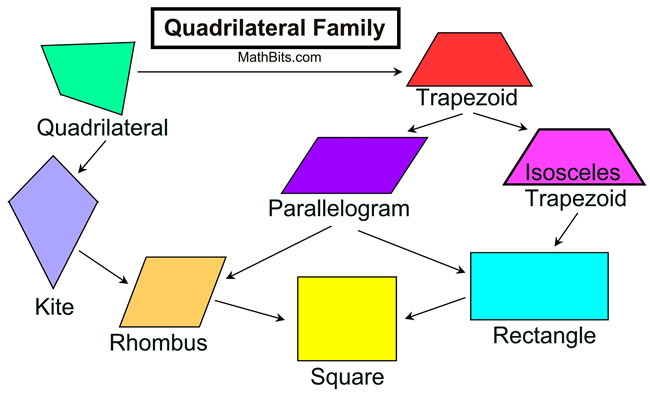
https://mathbitsnotebook.com/Geometry/Quadrilaterals/QuadFamilyChart.jpg
https://i.pinimg.com/736x/e4/c4/06/e4c4069c8ac1bb5747c0b5ebd36c2f4d.jpg
https://i.pinimg.com/564x/43/4a/74/434a745ebcc4d1b46113d49d78e46027.jpg
4

III. Important Questions

(A) MCQs (1 Mark)

  1. The sum of interior angles of a quadrilateral is:
    (a) 180° (b) 270° (c) 360° (d) 90°
    Answer: (c) 360°
  2. A quadrilateral with all sides equal is:
    (a) Rectangle (b) Rhombus (c) Trapezium (d) Kite
    Answer: (b) Rhombus
  3. A rectangle has:
    (a) All sides equal (b) All angles 90° (c) Only one pair parallel (d) None
    Answer: (b) All angles 90°
  4. Which quadrilateral has only one pair of parallel sides?
    (a) Square (b) Rectangle (c) Trapezium (d) Rhombus
    Answer: (c) Trapezium

(B) Short Answer Questions (2/3 Marks)

  1. Define a quadrilateral with an example.
  2. State the properties of a parallelogram.
  3. What is the difference between a square and a rectangle?
  4. Find the missing angle if three angles of a quadrilateral are 90°, 80°, and 70°.

(C) Long Answer Questions (5 Marks)

  1. Explain the angle sum property of a quadrilateral with an example.
  2. Compare properties of square, rectangle, and rhombus.
  3. Prove that opposite angles of a parallelogram are equal.
  4. Solve problems based on missing angles in quadrilaterals.

(D) HOTS Questions

  1. Can a quadrilateral have three right angles? Justify your answer.
  2. A quadrilateral has angles 90°, 90°, 90°, and 90°. Identify the quadrilateral and justify.

IV. Key Formulas / Concepts

  • Sum of angles = 360°
  • Opposite sides of parallelogram are equal
  • Diagonals of parallelogram bisect each other

Example:
If three angles are 80°, 90°, 100°, then fourth angle =
360° – (80° + 90° + 100°) = 90°


V. Deleted Portions (CBSE 2025–2026)

No portions have been deleted from this chapter as per the rationalized NCERT textbooks.


VI. Chapter-Wise Marks Bifurcation (Estimated – CBSE 2025–2026)

Unit/Chapter Estimated Marks Type of Questions Typically Asked
Quadrilaterals 5–7 Marks MCQs, Short Answer, Diagram-based

Note: This is an estimate. Actual marks distribution may vary.


VII. Previous Year Questions (PYQs)

1 Mark

  • What is the sum of angles of a quadrilateral? (CBSE 2020)

2/3 Marks

  • Find the unknown angle in a quadrilateral. (CBSE 2019)

5 Marks

  • Explain properties of parallelogram with diagram. (CBSE 2018)

VIII. Real-World Application Examples

  • Architecture: Windows, doors, and tiles are quadrilateral shapes.
  • Engineering: Bridge designs use parallelogram structures.
  • Daily Objects: Books, screens, tables are rectangular.
  • Design & Art: Patterns and layouts use quadrilateral shapes.

IX. Student Tips & Strategies for Success

Time Management

  • Practice diagrams regularly.
  • Revise properties daily.

Exam Preparation

  • Learn properties of each quadrilateral.
  • Practice angle-based problems.

Stress Management

  • Use diagrams to visualize concepts.
  • Break problems into smaller steps.

X. Career Guidance & Exploration (Class 8 Level)

  • Important for:
    • Architecture & Design
    • Civil Engineering
    • Graphic Designing
  • Builds spatial and logical thinking skills.

XI. Important Notes

  • Draw neat and labeled diagrams in exams.
  • Focus on understanding properties.
  • Practice numerical problems regularly.
  • Refer to CBSE updates for latest syllabus.

Create your account

Cart

No products in the cart.