

Class 8 Mathematics Chapter 5 Number Play (New Course)

  • Home
  • Class 8 Mathematics Chapter 5 Number Play (New Course)
ptitle-particle2
ptitle-particle1

Report a question

You cannot submit an empty report. Please add some details.

Class 8 Mathematics Chapter 5 Number Play (New Course)

This quiz on Class 8 Mathematics Chapter 5: Number Play is designed to test students’ understanding of various concepts related to numbers and their properties. It includes questions that assess knowledge of prime and composite numbers, divisibility rules, factors and multiples, HCF and LCM, and patterns in numbers. Students will also apply logical reasoning to solve problems involving number puzzles and basic arithmetic properties. The quiz aims to strengthen analytical skills, enhance problem-solving abilities, and encourage learners to think critically while exploring the fascinating world of numbers in a playful and engaging way.

1 / 240

Topic/Sub Topic: Algebraic justification

1. Which of the following pairs are both multiples of 7?

2 / 240

Topic/Sub Topic: Algebraic justification

2. What is the sum of two multiples of 8?

3 / 240

Topic/Sub Topic: Algebraic justification

3. If a number is divisible by 12, what can we conclude about its divisibility by the factors of 12?

4 / 240

Topic/Sub Topic: Algebraic justification

4. Consider two numbers that are both multiples of 7. Which expression below would NOT necessarily be divisible by 7?

5 / 240

Topic/Sub Topic: Algebraic justification

5. (A) If a number is divisible by 8, then all multiples of that number will be divisible by 8.
(R) Multiplying a multiple of 8 by any integer results in another multiple of 8.

6 / 240

Topic/Sub Topic: Algebraic justification

6. (A) If a number is divisible by 12, then all its multiples are also divisible by 12.
(R) If $M$ is divisible by $k$, then any multiple of $M$ can be expressed as $kmn$ where $n$ is an integer.

7 / 240

Topic/Sub Topic: Algebraic justification

7. If a number $N$ is divisible by both 6 and 8, what is the smallest positive number that must divide $N^2 – 1$?

8 / 240

Topic/Sub Topic: Algebraic justification

8. (A) If a number is divisible by 12, then it is also divisible by all the factors of 12.
(R) A number divisible by a given number must be divisible by all its factors.

9 / 240

Topic/Sub Topic: Algebraic justification

9. A student claims: “If a number is divisible by 10, then it must also be divisible by any multiple of 10.” Is this statement always, sometimes, or never true?

10 / 240

Topic/Sub Topic: Algebraic justification

10. If $x$ is divisible by 8 and $y$ is divisible by 8, which of the following must also be divisible by 8?

11 / 240

Topic/Sub Topic: Algebraic justification

11. If both $M$ and $N$ are multiples of 5, which statement is always true?

12 / 240

Topic/Sub Topic: Algebraic justification

12. Consider two numbers M and N which are both multiples of 7. Which of the following statements is true about the difference $(M – N)$?

13 / 240

Topic/Sub Topic: Digits in Disguise (Cryptarithms)

13. Solve the cryptarithm: $GH \times H = 9K$ where letters represent distinct digits and no leading digit is zero.

14 / 240

Topic/Sub Topic: Digits in Disguise (Cryptarithms)

14. Solve the cryptarithm: $A1 + 1B = B0$

15 / 240

Topic/Sub Topic: Digits in Disguise (Cryptarithms)

15. In the cryptarithm $AB \times C = DE$ where each letter represents a unique digit from 0 to 9, and no leading digit is zero, which of the following could be a valid solution for $AB \times C = DE$?

16 / 240

Topic/Sub Topic: Digits in Disguise (Cryptarithms)

16. Solve the cryptarithm: $PQ \times 8 = RS$

17 / 240

Topic/Sub Topic: Digits in Disguise (Cryptarithms)

17. A number has a digital root of 5. What will be the digital root of that number multiplied by 4?

18 / 240

Topic/Sub Topic: Digits in Disguise (Cryptarithms)

18. Solve the cryptarithm $ABC + BAC = CDA$ where all letters represent unique digits from 0 to 9, and $A,B,C,D$ are non-zero. Which option correctly solves it?

19 / 240

Topic/Sub Topic: Digits in Disguise (Cryptarithms)

19. Solve the cryptarithm: $A1 + 1B = B0$ where each letter represents a unique digit and no leading digit is zero.

20 / 240

Topic/Sub Topic: Digits in Disguise (Cryptarithms)

20. (A) In the cryptarithm $AB \times 5 = BC$, the digit A must be 1.
(R) If A were 2 or greater, multiplying by 5 would result in a 3-digit number.

21 / 240

Topic/Sub Topic: Digits in Disguise (Cryptarithms)

21. Solve the cryptarithm: $ON + ON + ON = PO$

22 / 240

Topic/Sub Topic: Digits in Disguise (Cryptarithms)

22. (A) In the cryptarithm $AB \times 5 = BC$, if $A = 1$, then $B$ must be 5.
(R) The first digit of a number in a cryptarithm cannot be 0.

23 / 240

Topic/Sub Topic: Digits in Disguise (Cryptarithms)

23. (A) In the cryptarithm $JK \times 6 = KKK$, if $K$ is an even digit, then $J$ must be 1.
(R) The product of a 2-digit number and 6 resulting in a 3-digit number where all digits are equal implies the tens digit of the original number must be 1 to avoid exceeding the range.

24 / 240

Topic/Sub Topic: Digits in Disguise (Cryptarithms)

24. Consider the cryptarithm $PQ \times Q = RST$ where each letter represents a unique digit from 0 to 9, and $P,Q,R,S,T$ are non-zero. Which of the following satisfies this equation?

25 / 240

Topic/Sub Topic: A Shortcut for Divisibility by 9

25. What is the remainder when 7309 is divided by 9?

26 / 240

Topic/Sub Topic: A Shortcut for Divisibility by 9

26. How many multiples of 9 lie between 4300 and 4400?

27 / 240

Topic/Sub Topic: A Shortcut for Divisibility by 9

27. Which of the following numbers is divisible by 9?

28 / 240

Topic/Sub Topic: A Shortcut for Divisibility by 9

28. (A) The number $987654321$ is divisible by $9$.
(R) The sum of the digits of $987654321$, when added repeatedly until a single digit is obtained, equals $9$.

29 / 240

Topic/Sub Topic: A Shortcut for Divisibility by 9

29. What is the remainder when 358095 is divided by 9?

30 / 240

Topic/Sub Topic: A Shortcut for Divisibility by 9

30. What is the remainder when the number 8473 is divided by 9?

31 / 240

Topic/Sub Topic: A Shortcut for Divisibility by 9

31. (A) The number 909 is divisible by 9.
(R) The sum of the digits of 909 is a multiple of 9.

32 / 240

Topic/Sub Topic: A Shortcut for Divisibility by 9

32. Which of the following numbers is divisible by 9?

33 / 240

Topic/Sub Topic: A Shortcut for Divisibility by 9

33. Which statement about divisibility by 9 is correct?

34 / 240

Topic/Sub Topic: A Shortcut for Divisibility by 9

34. Find the smallest three-digit number that is divisible by 9.

35 / 240

Topic/Sub Topic: A Shortcut for Divisibility by 9

35. Which of the following numbers is divisible by 9?

36 / 240

Topic/Sub Topic: A Shortcut for Divisibility by 9

36. (A) The number 12345 is divisible by 9 because the sum of its digits, 15, is divisible by 9.
(R) A number is divisible by 9 if and only if the sum of its digits is divisible by 9.

37 / 240

Topic/Sub Topic: Is This a Multiple Of?

37. Which of the following numbers is a multiple of 8?

38 / 240

Topic/Sub Topic: Is This a Multiple Of?

38. If a number is divisible by 12, which of the following must it also be divisible by?

39 / 240

Topic/Sub Topic: Is This a Multiple Of?

39. If a number $N$ is divisible by both 15 and 14, which of the following must be true about $N$?

40 / 240

Topic/Sub Topic: Is This a Multiple Of?

40. Using the divisibility rule for 11, determine which of the following numbers is divisible by 11.

41 / 240

Topic/Sub Topic: Is This a Multiple Of?

41. (A) If a number is divisible by 6, it must also be divisible by 3.
(R) 6 is a multiple of 3.

42 / 240

Topic/Sub Topic: Is This a Multiple Of?

42. If a number is divisible by both 6 and 8, which of the following must it also be divisible by?

43 / 240

Topic/Sub Topic: Is This a Multiple Of?

43. (A) If a number is divisible by both 6 and 4, it must be divisible by 24.
(R) The LCM of 6 and 4 is 24.

44 / 240

Topic/Sub Topic: Is This a Multiple Of?

44. A number is given as 765432. What is the remainder when this number is divided by 11?

45 / 240

Topic/Sub Topic: Is This a Multiple Of?

45. Which of the following statements is always true?

46 / 240

Topic/Sub Topic: Is This a Multiple Of?

46. Which algebraic expression represents numbers that leave a remainder of 3 when divided by 5?

47 / 240

Topic/Sub Topic: Is This a Multiple Of?

47. A number leaves a remainder of 4 when divided by 6 and a remainder of 3 when divided by 5. What is the smallest positive integer that satisfies these conditions?

48 / 240

Topic/Sub Topic: Is This a Multiple Of?

48. (A) If a number is divisible by both 6 and 8, it must be divisible by 48.
(R) The least common multiple (LCM) of 6 and 8 is 48.

49 / 240

Topic/Sub Topic: Patterns and parity

49. Consider two even numbers where one is a multiple of 4 and the other is not. What will be the remainder when their sum is divided by 4?

50 / 240

Topic/Sub Topic: Patterns and parity

50. Under what condition will the sum of two even numbers be a multiple of 4?

51 / 240

Topic/Sub Topic: Patterns and parity

51. Which of the following expressions always evaluates to an even number for any integer values of the variables?

52 / 240

Topic/Sub Topic: Patterns and parity

52. (A) The expression $4m + 2n$ always yields an even number.
(R) Both $4m$ and $2n$ are multiples of 2.

53 / 240

Topic/Sub Topic: Patterns and parity

53. (A) The expression $(4p + 2) + (4q + 2)$ always results in a multiple of 4 for any integers $p$ and $q$.
(R) Adding two numbers that each leave a remainder of 2 when divided by 4 yields a sum divisible by 4.

54 / 240

Topic/Sub Topic: Patterns and parity

54. Which of the following algebraic expressions will always yield an even number for any integer values of the variables involved?

55 / 240

Topic/Sub Topic: Patterns and parity

55. What is the parity of the expression $3g + 5h$ for any integer values of $g$ and $h$?

56 / 240

Topic/Sub Topic: Patterns and parity

56. (A) The sum of two even numbers that both leave a remainder of 2 when divided by 4 is always a multiple of 4.
(R) When two numbers of the form $4k + 2$ are added, the result is $4(k_1 + k_2 + 1)$, ensuring divisibility by 4.

57 / 240

Topic/Sub Topic: Patterns and parity

57. When two even numbers are added, under what condition is their sum a multiple of 4?

58 / 240

Topic/Sub Topic: Patterns and parity

58. Consider the expression $a + b – c – d$. What happens to its parity if we change the sign of $b$ from $+$ to $-$?

59 / 240

Topic/Sub Topic: Patterns and parity

59. If two even numbers are added and the result is a multiple of 4, which of the following must be true about the two numbers?

60 / 240

Topic/Sub Topic: Patterns and parity

60. Which of the following expressions will always yield an even number for any integer values of the variables?

61 / 240

Topic/Sub Topic: A Shortcut for Divisibility by 11

61. Which of the following numbers is divisible by 11?

62 / 240

Topic/Sub Topic: A Shortcut for Divisibility by 11

62. If the difference between the sum of digits in odd places and even places of a number is 22, what can be concluded about its divisibility by 11?

63 / 240

Topic/Sub Topic: A Shortcut for Divisibility by 11

63. What is the remainder when 583 is divided by 11?

64 / 240

Topic/Sub Topic: A Shortcut for Divisibility by 11

64. Which of the following numbers is divisible by 11?

65 / 240

Topic/Sub Topic: A Shortcut for Divisibility by 11

65. Which of the following numbers will leave a remainder of 8 when divided by 11?

66 / 240

Topic/Sub Topic: A Shortcut for Divisibility by 11

66. (A) The number $123456$ is divisible by $11$.
(R) The alternating sum of the digits of $123456$ equals zero.

67 / 240

Topic/Sub Topic: A Shortcut for Divisibility by 11

67. What is the remainder when 275 is divided by 11?

68 / 240

Topic/Sub Topic: A Shortcut for Divisibility by 11

68. (A) The number 90904 is divisible by 11.
(R) The difference between the sum of digits in odd positions and even positions of 90904 is a multiple of 11.

69 / 240

Topic/Sub Topic: A Shortcut for Divisibility by 11

69. (A) The number 462 is divisible by 11.
(R) For the number 462, the difference between the sum of digits in odd places and even places is zero.

70 / 240

Topic/Sub Topic: A Shortcut for Divisibility by 11

70. Which of the following numbers is NOT divisible by 11?

71 / 240

Topic/Sub Topic: A Shortcut for Divisibility by 11

71. What is the remainder when $72581$ is divided by 11?

72 / 240

Topic/Sub Topic: A Shortcut for Divisibility by 11

72. The number $857076$ is:

73 / 240

Topic/Sub Topic: Always, Sometimes, or Never

73. (A) If a number is divisible by both 4 and 6, it must be divisible by 24.
(R) The product of two numbers always divides their LCM.

74 / 240

Topic/Sub Topic: Always, Sometimes, or Never

74. If a number is divisible by both 9 and 4, what must it also be divisible by?

75 / 240

Topic/Sub Topic: Always, Sometimes, or Never

75. What is true about the product of an even number and an odd number?

76 / 240

Topic/Sub Topic: Always, Sometimes, or Never

76. The sum of two numbers where one is a multiple of 5 and the other is a multiple of 7 is a multiple of 35. Is this always, sometimes, or never true?

77 / 240

Topic/Sub Topic: Always, Sometimes, or Never

77. If a number is divisible by both 6 and 8, is it always, sometimes, or never divisible by 48?

78 / 240

Topic/Sub Topic: Always, Sometimes, or Never

78. (A) The sum of a multiple of 4 and a multiple of 6 is always divisible by 12.
(R) The LCM of 4 and 6 is 12.

79 / 240

Topic/Sub Topic: Always, Sometimes, or Never

79. If a number is divisible by 8, what can we say about the sum of any two such numbers?

80 / 240

Topic/Sub Topic: Always, Sometimes, or Never

80. (A) If a number is divisible by both 9 and 4, it must be divisible by 36.
(R) The least common multiple (LCM) of 9 and 4 is 36.

81 / 240

Topic/Sub Topic: Always, Sometimes, or Never

81. Is the following statement always true, sometimes true, or never true? If a number is divisible by both 6 and 4, it must be divisible by 24.

82 / 240

Topic/Sub Topic: Always, Sometimes, or Never

82. If a number is divisible by 12, then it is:

83 / 240

Topic/Sub Topic: Always, Sometimes, or Never

83. Is the following statement always true, sometimes true, or never true? If a number is divisible by 9, then it is also divisible by any multiple of 9.

84 / 240

Topic/Sub Topic: Always, Sometimes, or Never

84. Is the following statement always true, sometimes true, or never true? The sum of two odd numbers is a multiple of 6.

85 / 240

Topic/Sub Topic: Pairs to Make Fours

85. Which pair of even numbers will always result in a sum that is not divisible by 4?

86 / 240

Topic/Sub Topic: Pairs to Make Fours

86. Which pair of even numbers will have a sum that is a multiple of 4?

87 / 240

Topic/Sub Topic: Pairs to Make Fours

87. (A) The sum of any two even numbers that are not multiples of 4 is always divisible by 4.
(R) When two even numbers not divisible by 4 are added, their remainders (2 each) sum to 4, making the total sum a multiple of 4.

88 / 240

Topic/Sub Topic: Pairs to Make Fours

88. If you add two even numbers and the sum is 24, what could the numbers be? (Hint: Both must either be multiples of 4 or leave remainder 2 when divided by 4)

89 / 240

Topic/Sub Topic: Pairs to Make Fours

89. If you add the even numbers 14 and 18, will the result be divisible by 4?

90 / 240

Topic/Sub Topic: Pairs to Make Fours

90. Which of the following pairs does NOT have a sum divisible by 4?

91 / 240

Topic/Sub Topic: Pairs to Make Fours

91. Consider the sum of two even numbers where one is a multiple of 4 and the other is not. Under what condition will their sum be divisible by 4?

92 / 240

Topic/Sub Topic: Pairs to Make Fours

92. (A) The sum of two even numbers that leave a remainder of 2 when divided by 4 is always divisible by 4.
(R) When two even numbers not divisible by 4 are added, their remainders (each being 2) sum to 4, making the total divisible by 4.

93 / 240

Topic/Sub Topic: Pairs to Make Fours

93. Take the numbers 20 (a multiple of 4) and 10 (not a multiple of 4). Is their sum divisible by 4?

94 / 240

Topic/Sub Topic: Pairs to Make Fours

94. (A) The sum of two even numbers that are multiples of 4 is always a multiple of 4.
(R) Even numbers that are multiples of 4 leave a remainder of 0 when divided by 4.

95 / 240

Topic/Sub Topic: Pairs to Make Fours

95. If the sum of two even numbers is 32, which of the following cannot be a possible pair?

96 / 240

Topic/Sub Topic: Pairs to Make Fours

96. Consider two even numbers, 24 and 36. Is their sum divisible by 4?

97 / 240

Topic/Sub Topic: More on Divisibility Shortcuts

97. A number M has a digital root of 9 and leaves a remainder of 2 when divided by 11. What is the smallest positive value of M that satisfies these conditions?

98 / 240

Topic/Sub Topic: More on Divisibility Shortcuts

98. Consider a number P such that P is divisible by both 3 and 8. Which of the following statements must be true about P?

99 / 240

Topic/Sub Topic: More on Divisibility Shortcuts

99. Which number is divisible by 24?

100 / 240

Topic/Sub Topic: More on Divisibility Shortcuts

100. A number N has a digital root of 3 and is divisible by 6. Which of the following could be the remainder when N is divided by 11?

101 / 240

Topic/Sub Topic: More on Divisibility Shortcuts

101. (A) The number 186 is divisible by 6.
(R) A number divisible by both 2 and 3 is always divisible by 6.

102 / 240

Topic/Sub Topic: More on Divisibility Shortcuts

102. Which of the following numbers is divisible by 6?

103 / 240

Topic/Sub Topic: More on Divisibility Shortcuts

103. (A) A number is divisible by 6 if it has a digital root of 3, 6, or 9.
(R) The digital root of any multiple of 3 is always 3, 6, or 9.

104 / 240

Topic/Sub Topic: More on Divisibility Shortcuts

104. The digital root of a number is obtained by repeatedly adding its digits until a single-digit number is obtained. What is the digital root of 76985?

105 / 240

Topic/Sub Topic: More on Divisibility Shortcuts

105. Which of the following numbers is divisible by 6?

106 / 240

Topic/Sub Topic: More on Divisibility Shortcuts

106. What is the remainder when 58432 is divided by 11 using the divisibility rule for 11?

107 / 240

Topic/Sub Topic: More on Divisibility Shortcuts

107. What is the remainder when 328105 is divided by 11?

108 / 240

Topic/Sub Topic: More on Divisibility Shortcuts

108. (A) The number 999 is divisible by 9.
(R) The sum of the digits of 999 is divisible by 9.

109 / 240

Topic/Sub Topic: Checking Divisibility Quickly

109. Which of the following numbers is divisible by 11?

110 / 240

Topic/Sub Topic: Checking Divisibility Quickly

110. What is the digital root of the number 6795?

111 / 240

Topic/Sub Topic: Checking Divisibility Quickly

111. The number 873 is divisible by which of the following?

112 / 240

Topic/Sub Topic: Checking Divisibility Quickly

112. Which of these statements about a number N is sufficient to conclude it’s divisible by 12?

113 / 240

Topic/Sub Topic: Checking Divisibility Quickly

113. (A) The number 405 is divisible by 9.
(R) The sum of the digits of 405 is 9, which is divisible by 9.

114 / 240

Topic/Sub Topic: Checking Divisibility Quickly

114. Which of the following numbers is divisible by 9?

115 / 240

Topic/Sub Topic: Checking Divisibility Quickly

115. A five-digit number has digits in strictly increasing order from left to right, and is divisible by 9. What could be its digital root?

116 / 240

Topic/Sub Topic: Checking Divisibility Quickly

116. (A) The number 123456 is divisible by 3.
(R) The sum of the digits of 123456 is divisible by 3.

117 / 240

Topic/Sub Topic: Checking Divisibility Quickly

117. (A) The number 908172 is divisible by 11.
(R) The alternating sum of the digits of 908172 ($-9 + 0 – 8 + 1 – 7 + 2$) equals $-21$, which is divisible by 11.

118 / 240

Topic/Sub Topic: Checking Divisibility Quickly

118. Which of the following numbers is divisible by both 3 and 9?

119 / 240

Topic/Sub Topic: Checking Divisibility Quickly

119. Which number is divisible by both 5 and 2?

120 / 240

Topic/Sub Topic: Checking Divisibility Quickly

120. When the number $N = 100a + 10b + c$ is divided by 11, the remainder is equal to which expression?

121 / 240

Topic/Sub Topic: Concept of digital roots

121. What is the digital root of the number obtained by multiplying 123456789 by 9?

122 / 240

Topic/Sub Topic: Concept of digital roots

122. What is the digital root of the number 8675?

123 / 240

Topic/Sub Topic: Concept of digital roots

123. In the cryptarithm $AB + 37 = 6A$, where $A$ and $B$ are digits, what is the digital root of the number $AB$?

124 / 240

Topic/Sub Topic: Concept of digital roots

124. (A) The digital root of 1234 is 1.
(R) The sum of the digits of 1234 is $1 + 2 + 3 + 4 = 10$, and further $1 + 0 = 1$.

125 / 240

Topic/Sub Topic: Concept of digital roots

125. (A) The digital root of the number 12345 is 6.
(R) The sum of the digits of 12345 is 15, and the digital root is obtained by summing the digits until a single-digit number is achieved.

126 / 240

Topic/Sub Topic: Concept of digital roots

126. Which of the following numbers is divisible by 9 based on its digital root?

127 / 240

Topic/Sub Topic: Concept of digital roots

127. If the digital root of a number is 4, what is the remainder when the number is divided by 9?

128 / 240

Topic/Sub Topic: Concept of digital roots

128. Which of the following numbers is divisible by 9 based on its digital root?

129 / 240

Topic/Sub Topic: Concept of digital roots

129. If the digital root of a number is 7, what is the remainder when this number is divided by 9?

130 / 240

Topic/Sub Topic: Concept of digital roots

130. If the digital root of a number is 4, what will be the digital root of the number when 5 is added to it?

131 / 240

Topic/Sub Topic: Concept of digital roots

131. (A) The digital root of $N = 9k + r$ is always equal to the remainder $r$ when $N$ is divided by 9.
(R) The sum of the digits of any number congruent to $r$ modulo 9 will reduce to $r$ through repeated digit summation.

132 / 240

Topic/Sub Topic: Concept of digital roots

132. What is the digital root of the number 729?

133 / 240

Topic/Sub Topic: Connection with divisibility

133. If a number is divisible by 36, which of the following must also be divisible by all factors of this number?

134 / 240

Topic/Sub Topic: Connection with divisibility

134. Which number is divisible by 5?

135 / 240

Topic/Sub Topic: Connection with divisibility

135. What is the sum of the digits of 729, and is it divisible by 9?

136 / 240

Topic/Sub Topic: Connection with divisibility

136. (A) A number divisible by both 3 and 8 must also be divisible by 24.
(R) The least common multiple (LCM) of 3 and 8 is 24.

137 / 240

Topic/Sub Topic: Connection with divisibility

137. If both $M$ and $N$ are divisible by 7, which of the following expressions must also be divisible by 7?

138 / 240

Topic/Sub Topic: Connection with divisibility

138. Which of the following numbers is divisible by 10?

139 / 240

Topic/Sub Topic: Connection with divisibility

139. A number has a digital root of 5 when the sum of its digits is repeatedly calculated until a single-digit number is obtained. Which of the following numbers between 600 and 700 satisfies this condition?

140 / 240

Topic/Sub Topic: Connection with divisibility

140. If a number $n$ is divisible by both 15 and 20, which of the following must necessarily divide $n$?

141 / 240

Topic/Sub Topic: Connection with divisibility

141. Which of the following numbers is divisible by 10?

142 / 240

Topic/Sub Topic: Connection with divisibility

142. (A) The number 123456789 is divisible by 9.
(R) The sum of the digits of 123456789 is divisible by 9.

143 / 240

Topic/Sub Topic: Connection with divisibility

143. (A) The number 120 is divisible by 10.
(R) A number is divisible by 10 if its units digit is 0.

144 / 240

Topic/Sub Topic: Connection with divisibility

144. Consider the following statements about divisibility rules:
I. A number divisible by both 4 and 6 is always divisible by 24.
II. A number divisible by both 3 and 8 is always divisible by 24.
Which of these statements is/are correct?

145 / 240

Topic/Sub Topic: Digital Roots

145. A number is divisible by both $3$ and $8$. Which of the following must also be divisible by $24$?

146 / 240

Topic/Sub Topic: Digital Roots

146. If the digital root of a number is 4, what will be the digital root of its double?

147 / 240

Topic/Sub Topic: Digital Roots

147. (A) The digital root of 369 is 9.
(R) A number whose digital root is 9 is divisible by 9.

148 / 240

Topic/Sub Topic: Digital Roots

148. A number has a digital root of 3. What will be the digital root of the next consecutive number (number + 1)?

149 / 240

Topic/Sub Topic: Digital Roots

149. In the cryptarithm $AB + 37 = 6A$, where each letter represents a unique digit, what is the digital root of the two-digit number $AB$?

150 / 240

Topic/Sub Topic: Digital Roots

150. The digital root of an 8-digit number is 5. What will be the digital root of 10 more than that number?

151 / 240

Topic/Sub Topic: Digital Roots

151. (A) The digital root of $9a + 36b + 13$ is always the same as the digital root of $a + b + 4$.
(R) The digital root of a number remains unchanged when multiples of 9 are added or subtracted from it.

152 / 240

Topic/Sub Topic: Digital Roots

152. (A) The digital root of a number is equal to the remainder when the number is divided by 9.

(R) The sum of digits of a number always leaves the same remainder as the number itself when divided by 9.

153 / 240

Topic/Sub Topic: Digital Roots

153. If the digital root of a number is 6, what can be said about its divisibility by 9?

154 / 240

Topic/Sub Topic: Digital Roots

154. In the cryptarithm $A1 + 1B = B0$, where $A$ and $B$ are distinct digits, what is the value of $A + B$ if the digital root of the sum $B0$ is $9$?

155 / 240

Topic/Sub Topic: Digital Roots

155. What is the digital root of the number 1234?

156 / 240

Topic/Sub Topic: Digital Roots

156. What is the digital root of the number 729?

157 / 240

Topic/Sub Topic: A Shortcut for Divisibility by 3

157. What is the digital root of the number 489710?

158 / 240

Topic/Sub Topic: A Shortcut for Divisibility by 3

158. (A) The number 246 is divisible by 3.
(R) The sum of the digits of 246 is divisible by 3.

159 / 240

Topic/Sub Topic: A Shortcut for Divisibility by 3

159. Which of the following numbers is divisible by 3?

160 / 240

Topic/Sub Topic: A Shortcut for Divisibility by 3

160. What is the smallest multiple of 3 with no odd digits?

161 / 240

Topic/Sub Topic: A Shortcut for Divisibility by 3

161. Which of the following statements is true about the number 6000 regarding its divisibility by 3?

162 / 240

Topic/Sub Topic: A Shortcut for Divisibility by 3

162. A number is 1 less than a multiple of 3. When you add 5 to this number, what happens to its divisibility by 3?

163 / 240

Topic/Sub Topic: A Shortcut for Divisibility by 3

163. Find the multiple of 3 closest to 6000.

164 / 240

Topic/Sub Topic: A Shortcut for Divisibility by 3

164. (A) The number 255 is divisible by 3.
(R) The sum of the digits of 255 is 12, which is divisible by 3.

165 / 240

Topic/Sub Topic: A Shortcut for Divisibility by 3

165. A five-digit number has all its digits odd and unique. The sum of its digits is divisible by 3. What could be the smallest such number?

166 / 240

Topic/Sub Topic: A Shortcut for Divisibility by 3

166. Which of the following numbers is not divisible by 3?

167 / 240

Topic/Sub Topic: A Shortcut for Divisibility by 3

167. (A) If the digital root of a number is divisible by 3, then the number itself must be divisible by 3.
(R) The digital root method works because it simplifies the divisibility rule for 3 by reducing the sum of digits iteratively to a single digit.

168 / 240

Topic/Sub Topic: A Shortcut for Divisibility by 3

168. How many three-digit numbers formed using the digits 2, 4, 6 exactly once are divisible by 3?

169 / 240

Topic/Sub Topic: Divisibility rules

169. Determine which of the following numbers is divisible by 11.

170 / 240

Topic/Sub Topic: Divisibility rules

170. Which of the following numbers is divisible by 5?

171 / 240

Topic/Sub Topic: Divisibility rules

171. Which of the following numbers is divisible by 10?

172 / 240

Topic/Sub Topic: Divisibility rules

172. (A) The number 405 is divisible by 9.
(R) The sum of the digits of 405 (4 + 0 + 5 = 9) is divisible by 9.

173 / 240

Topic/Sub Topic: Divisibility rules

173. Which of the following numbers is divisible by 9?

174 / 240

Topic/Sub Topic: Divisibility rules

174. (A) The number 123456 is divisible by 6.
(R) A number is divisible by 6 if it is divisible by both 2 and 3.

175 / 240

Topic/Sub Topic: Divisibility rules

175. What is the remainder when the number 75316842 is divided by 11?

176 / 240

Topic/Sub Topic: Divisibility rules

176. How many 4-digit numbers are divisible by both 6 and 9 but not by 12?

177 / 240

Topic/Sub Topic: Divisibility rules

177. Which of the following numbers is divisible by 3?

178 / 240

Topic/Sub Topic: Divisibility rules

178. A number has a digital root of 6 and is divisible by 9. Which of the following could be the number?

179 / 240

Topic/Sub Topic: Divisibility rules

179. Which number is divisible by 6?

180 / 240

Topic/Sub Topic: Divisibility rules

180. (A) The number $123456789$ is divisible by 9 because the sum of its digits is 45, which is a multiple of 9.
(R) A number is divisible by 9 if the digital root of the number is 9.

181 / 240

Topic/Sub Topic: Number system structure and algebraic form

181. A number is expressed as $N = 1000d + 100c + 10b + a$. If $N$ is divisible by both 5 and 9, which of the following must be true about its digits?

182 / 240

Topic/Sub Topic: Number system structure and algebraic form

182. Which of the following numbers is divisible by 10?

183 / 240

Topic/Sub Topic: Number system structure and algebraic form

183. Consider a 4-digit number in the form $N = 1000d + 100c + 10b + a$. Which condition ensures that $N$ is divisible by 8?

184 / 240

Topic/Sub Topic: Number system structure and algebraic form

184. Which number is divisible by 5?

185 / 240

Topic/Sub Topic: Number system structure and algebraic form

185. When divided by 7, the number 661 leaves a remainder of 3 and 4779 leaves a remainder of 5. What is the remainder when $4779 + 661$ is divided by 7?

186 / 240

Topic/Sub Topic: Number system structure and algebraic form

186. Find the smallest number that leaves a remainder of 2 when divided by 3, a remainder of 3 when divided by 4, and a remainder of 4 when divided by 5.

187 / 240

Topic/Sub Topic: Number system structure and algebraic form

187. Which of the following numbers is divisible by both 4 and 9?

188 / 240

Topic/Sub Topic: Number system structure and algebraic form

188. (A) The number 5430 is divisible by 10.
(R) A number is divisible by 10 if its units digit is 0.

189 / 240

Topic/Sub Topic: Number system structure and algebraic form

189. A number $N$ is written as $… + 1000d + 100c + 10b + a$. If $N$ is divisible by both 2 and 9, what must hold true?

190 / 240

Topic/Sub Topic: Number system structure and algebraic form

190. Which of these numbers is divisible by 9?

191 / 240

Topic/Sub Topic: Number system structure and algebraic form

191. (A) The number $1234567890$ is divisible by 10, but not by 100.
(R) A number is divisible by 10 if its last digit is 0, and divisible by 100 if its last two digits are 00.

192 / 240

Topic/Sub Topic: Number system structure and algebraic form

192. (A) The number 54320 is divisible by 10 because its units digit is 0.
(R) Any number in the form $…+1000d + 100c + 10b + a$ is divisible by 10 if and only if $a = 0$.

193 / 240

Topic/Sub Topic: Sums of consecutive numbers

193. The sum of three consecutive numbers is 45. What is the middle number?

194 / 240

Topic/Sub Topic: Sums of consecutive numbers

194. Three consecutive numbers satisfy the conditions: the first is a multiple of 2, the second is a multiple of 3, and the third is a multiple of 4. What could these numbers be?

195 / 240

Topic/Sub Topic: Sums of consecutive numbers

195. The greatest of five consecutive numbers is $p$. What is their sum in terms of $p$?

196 / 240

Topic/Sub Topic: Sums of consecutive numbers

196. (A) The sum of four consecutive numbers is always even.
(R) The sum of any two consecutive numbers is odd, and the sum of two such pairs will be even.

197 / 240

Topic/Sub Topic: Sums of consecutive numbers

197. (A) The number 10 can be expressed as the sum of consecutive numbers.
(R) All even numbers can be written as a sum of consecutive numbers.

198 / 240

Topic/Sub Topic: Sums of consecutive numbers

198. Find a number that leaves a remainder of 2 when divided by both 3 and 4. Which of the following satisfies this condition?

199 / 240

Topic/Sub Topic: Sums of consecutive numbers

199. Which of the following numbers cannot be expressed as the sum of two consecutive numbers?

200 / 240

Topic/Sub Topic: Sums of consecutive numbers

200. The sum of four consecutive numbers is 34. What are these numbers?

201 / 240

Topic/Sub Topic: Sums of consecutive numbers

201. (A) The sum of any four consecutive numbers is always even.

(R) For any integer $n$, the sum $n + (n+1) + (n+2) + (n+3)$ simplifies to $4n + 6$, which is divisible by 2.

202 / 240

Topic/Sub Topic: Sums of consecutive numbers

202. Which of the following numbers cannot be expressed as a sum of two or more consecutive natural numbers?

203 / 240

Topic/Sub Topic: Sums of consecutive numbers

203. What is the sum of three consecutive numbers if the middle number is 5?

204 / 240

Topic/Sub Topic: Sums of consecutive numbers

204. If four consecutive numbers add up to 30, what is the smallest number?

205 / 240

Topic/Sub Topic: Breaking Even

205. Two even numbers are added together. Under what condition will their sum be a multiple of 4?

206 / 240

Topic/Sub Topic: Breaking Even

206. For which expression will the result always be even regardless of the integer value substituted for the variable?

207 / 240

Topic/Sub Topic: Breaking Even

207. Which expression is guaranteed to be even for any integer value of $k$?

208 / 240

Topic/Sub Topic: Breaking Even

208. Which pair of even numbers will always give a sum divisible by 4?

209 / 240

Topic/Sub Topic: Breaking Even

209. Which of the following expressions will always yield an even number for any integer values of the variables?

210 / 240

Topic/Sub Topic: Breaking Even

210. (A) The expression $4k \times 3j$ always evaluates to an even number for any integer values of $k$ and $j$.
(R) The product of two even numbers is always even.

211 / 240

Topic/Sub Topic: Breaking Even

211. (A) The expression $4m + 2q$ always gives an even number for any integer values of $m$ and $q$.
(R) The expression can be factored as $2(2m + q)$, making it a multiple of 2.

212 / 240

Topic/Sub Topic: Breaking Even

212. Which expression is guaranteed to produce an even result for any integer input?

213 / 240

Topic/Sub Topic: Breaking Even

213. Which of the following expressions will always evaluate to an even number for any integer values of the variables?

214 / 240

Topic/Sub Topic: Breaking Even

214. Which of the following expressions will always evaluate to an even number for any integer values of the variables?

215 / 240

Topic/Sub Topic: Breaking Even

215. (A) The expression $6m – 3n$ will always evaluate to an even number for any integer values of $m$ and $n$.
(R) Both $6m$ and $3n$ are divisible by 3, making their difference divisible by 3 as well.

216 / 240

Topic/Sub Topic: Breaking Even

216. Two even numbers add up to a multiple of 4 when:

217 / 240

Topic/Sub Topic: Logical reasoning and algebra

217. (A) In the cryptarithm $TWO + TWO = FOUR$, if $F = 1$, then $T$ must be at least 5 to produce a carry-over that makes $F = 1$.
(R) The sum of two identical 3-digit numbers can result in a 4-digit number only if there is a carry-over from the most significant digit addition.

218 / 240

Topic/Sub Topic: Logical reasoning and algebra

218. If $P \times Q = R$ where $P = 2$, $Q = 4$, and all letters represent distinct digits, what is the value of $R$?

219 / 240

Topic/Sub Topic: Logical reasoning and algebra

219. In the cryptarithm $BE + BE = BAD$, where each letter represents a unique digit from 0 to 9 and no leading zeros are allowed, what is the value of $D$?

220 / 240

Topic/Sub Topic: Logical reasoning and algebra

220. If $A + B = C$ and all letters represent distinct digits from 0 to 9, which of the following is a possible value for $C$ if $A = 5$ and $B = 3$?

221 / 240

Topic/Sub Topic: Logical reasoning and algebra

221. In the cryptarithm $FOUR + FIVE = NINE$, where all letters represent unique digits and no leading zeros are allowed, what is the maximum possible value of $N$?

222 / 240

Topic/Sub Topic: Logical reasoning and algebra

222. In the equation $TWO + TWO = FOUR$, where each letter represents a unique digit from 0 to 9, what is the value of $F$ if $O = 4$ and $R = 8$?

223 / 240

Topic/Sub Topic: Logical reasoning and algebra

223. In the cryptarithm $EIGHT – THREE = FIVE$, where all letters represent unique digits, which digit cannot be assigned to $V$ if $I = 5$ and $H = 7$?

224 / 240

Topic/Sub Topic: Logical reasoning and algebra

224. If $AB \times C = DE$, where $A$, $B$, $C$, $D$, and $E$ are distinct digits, what must be the value of $C$ if $A = 2$ and $DE = 42$?

225 / 240

Topic/Sub Topic: Logical reasoning and algebra

225. In the cryptarithm $TWO + TWO = FOUR$, if $T = 1$ and $W = 0$, what is the minimum possible value of $O$ such that all letters represent distinct digits?

226 / 240

Topic/Sub Topic: Logical reasoning and algebra

226. In the cryptarithm $ONE + TWO = THREE$, where each letter represents a unique digit and no leading zeros are allowed, what is the value of $H$?

227 / 240

Topic/Sub Topic: Logical reasoning and algebra

227. (A) In the cryptarithm $AB + BA = CDE$, if A is 1, then C must be 1 because the sum of two 2-digit numbers cannot exceed 198.
(R) The maximum sum of two 2-digit numbers is $99 + 99 = 198$.

228 / 240

Topic/Sub Topic: Logical reasoning and algebra

228. (A) In the cryptarithm $TWO + TWO = FOUR$, the digit ‘O’ must be 1 because it is the only digit that satisfies the equation when considering the carry-over from the addition of ‘W’ and ‘W’.
(R) The sum of two identical digits (‘W’ + ‘W’) in the tens place will always result in an even number, which justifies the carry-over to the hundreds place.

229 / 240

Topic/Sub Topic: Letter–digit puzzles

229. In the cryptarithm $AB + 1 = BC$, where A, B, C are distinct digits, what is the value of $B$?

230 / 240

Topic/Sub Topic: Letter–digit puzzles

230. In the cryptarithm $AB \times 5 = BC$, where each letter represents a unique digit and no leading digit is zero, what is the value of $A + B + C$?

231 / 240

Topic/Sub Topic: Letter–digit puzzles

231. (A) In the cryptarithm $AB × 5 = BC$, $B$ must be 0 or 5 because the product ends with $C$ and $5 × B$ determines the units digit.
(R) The units digit of a product depends only on the units digits of the multiplicands.

232 / 240

Topic/Sub Topic: Letter–digit puzzles

232. Solve the cryptarithm $AB \times 5 = BC$, where each letter represents a unique digit and no digit is repeated.

233 / 240

Topic/Sub Topic: Letter–digit puzzles

233. In the cryptarithm $PQ × 8 = RS$, where P, Q, R, S are digits and P is non-zero, which of the following is a valid pair for (P, Q)?

234 / 240

Topic/Sub Topic: Letter–digit puzzles

234. (A) In the cryptarithm $PP \times QQ = PRP$, P must be 1 because any two-digit number multiplied by another two-digit number cannot yield a three-digit product if P is greater than 1.
(R) The maximum value of $PP \times QQ$ when P = 1 is $19 \times 99 = 1881$, which exceeds three digits, so P cannot be greater than 1.

235 / 240

Topic/Sub Topic: Letter–digit puzzles

235. Solve the cryptarithm $L2N \times 2 = 2NP$, where each letter represents a unique digit and no digit is repeated.

236 / 240

Topic/Sub Topic: Letter–digit puzzles

236. In the cryptarithm $L2N \times 2 = 2NP$, where each letter represents a unique digit and no leading digit is zero, what is the value of $P$?

237 / 240

Topic/Sub Topic: Letter–digit puzzles

237. (A) In the cryptarithm $EF \times E = GGG$, if $E = 7$ and $F = 9$, then $G$ must be 5.
(R) The product of a two-digit number ending with 9 and its tens digit must result in a three-digit number with all identical digits.

238 / 240

Topic/Sub Topic: Letter–digit puzzles

238. In the cryptarithm $JK \times 6 = KKK$, where each letter represents a unique digit and no leading digit is zero, what is the value of $J$?

239 / 240

Topic/Sub Topic: Letter–digit puzzles

239. Solve the cryptarithm $XY \times 4 = ZX$, where each letter represents a unique digit and no digit is repeated.

240 / 240

Topic/Sub Topic: Letter–digit puzzles

240. What is the value of A in the cryptarithm $A1 + 1B = B0$, where A and B are digits and A is non-zero?

Your score is

The average score is 17%

Class 8 → Mathematics → Chapter 5: Number Play (New Course)


I. Chapter Summary

This chapter explores the interesting patterns and properties of numbers, making mathematics fun and engaging. Students learn about factors, multiples, divisibility rules, prime and composite numbers, and number tricks. The chapter also introduces concepts like LCM (Least Common Multiple), HCF (Highest Common Factor), and their applications. Through patterns and logical reasoning, students develop strong number sense and problem-solving skills.


II. Key Concepts Covered

1. Factors and Multiples

  • Factors: Numbers that divide another number exactly
  • Example: Factors of 12 → 1, 2, 3, 4, 6, 12
  • Multiples: Numbers obtained by multiplying a number
  • Example: Multiples of 5 → 5, 10, 15, 20…

2. Prime and Composite Numbers

  • Prime Numbers: Numbers with only two factors (1 and itself)
  • Example: 2, 3, 5, 7
  • Composite Numbers: Numbers with more than two factors

3. Divisibility Rules

  • Divisible by 2 → Last digit even
  • Divisible by 3 → Sum of digits divisible by 3
  • Divisible by 5 → Ends with 0 or 5

4. HCF (Highest Common Factor)

  • Largest number that divides two or more numbers

5. LCM (Least Common Multiple)

  • Smallest number divisible by two or more numbers

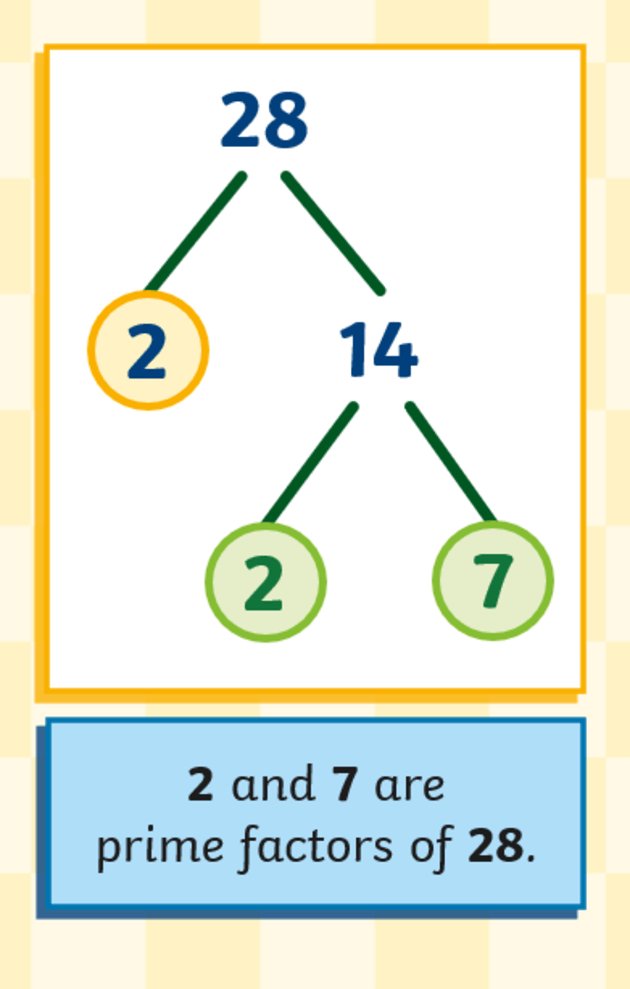
6. Prime Factorization

  • Expressing a number as a product of prime numbers
  • Example: $24 = 2 \times 2 \times 2 \times 3$

7. Number Patterns

  • Even–Odd patterns
  • Multiplication patterns
  • Number tricks and puzzles

Visual Understanding of Number Concepts
https://images.twinkl.co.uk/tw1n/image/private/t_630/u/ux/factor-trees-step-2_ver_1.png


III. Important Questions

(A) MCQs (1 Mark)

  1. Which of the following is a prime number?
    (a) 9 (b) 15 (c) 7 (d) 21
    Answer: (c) 7
  2. The HCF of 12 and 18 is:
    (a) 2 (b) 3 (c) 6 (d) 9
    Answer: (c) 6
  3. Which number is divisible by 5?
    (a) 42 (b) 55 (c) 63 (d) 48
    Answer: (b) 55
  4. The LCM of 4 and 6 is:
    (a) 10 (b) 12 (c) 24 (d) 6
    Answer: (b) 12

(B) Short Answer Questions (2/3 Marks)

  1. Find the factors of 20.
  2. Write the first five multiples of 7.
  3. Check whether 29 is a prime number.
  4. Find the HCF of 16 and 24.

(C) Long Answer Questions (5 Marks)

  1. Explain prime factorization with an example.
  2. Find the LCM of 12, 15, and 20 using prime factorization.
  3. Explain divisibility rules with examples.
  4. Solve problems involving HCF and LCM.

(D) HOTS Questions

  1. Find the smallest number divisible by both 6 and 8. Explain your method.
  2. A number leaves remainder 2 when divided by 5. What could be the number? Explain.

IV. Key Formulas / Concepts

  • HCF → Greatest common divisor
  • LCM → Least common multiple
  • Prime Factorization → Breaking into prime factors

Example:

  • $18 = 2 \times 3 \times 3$
  • HCF of 18 and 24 = 6
  • LCM of 18 and 24 = 72

V. Deleted Portions (CBSE 2025–2026)

No portions have been deleted from this chapter as per the rationalized NCERT textbooks.


VI. Chapter-Wise Marks Bifurcation (Estimated – CBSE 2025–2026)

Unit/Chapter Estimated Marks Type of Questions Typically Asked
Number Play 5–7 Marks MCQs, Short Answer, Application-based

Note: This is an estimate. Actual marks distribution may vary.


VII. Previous Year Questions (PYQs)

1 Mark

  • Identify a prime number from given options. (CBSE 2020)

2/3 Marks

  • Find HCF of two numbers. (CBSE 2019)

5 Marks

  • Solve problems using LCM and HCF. (CBSE 2018)

VIII. Real-World Application Examples

  • Timetables: LCM helps in finding common intervals.
  • Grouping: HCF helps in equal distribution.
  • Shopping: Divisibility helps in calculations.
  • Coding & Cryptography: Prime numbers are widely used.

IX. Student Tips & Strategies for Success

Time Management

  • Practice factorization daily.
  • Revise divisibility rules.

Exam Preparation

  • Learn prime numbers up to 50.
  • Practice LCM and HCF problems.

Stress Management

  • Solve puzzles to make learning fun.
  • Stay consistent with practice.

X. Career Guidance & Exploration (Class 8 Level)

  • Important for:
    • Mathematics & Statistics
    • Computer Science
    • Finance & Banking
  • Builds logical reasoning and analytical thinking.

XI. Important Notes

  • Practice prime factorization regularly.
  • Learn divisibility rules thoroughly.
  • Focus on understanding concepts, not memorizing.
  • Refer to NCERT and CBSE updates.

Create your account

Cart

No products in the cart.