



Report a question

Class 8 → Mathematics → Chapter 4: Quadrilaterals (New Course)
I. Chapter Summary
This chapter focuses on quadrilaterals, which are polygons having four sides. Students learn about different types of quadrilaterals such as parallelogram, rectangle, square, rhombus, and trapezium, along with their properties. The chapter explains relationships between sides, angles, and diagonals, and helps students understand how to classify quadrilaterals. It also introduces the angle sum property and practical applications of quadrilaterals in daily life, architecture, and design.
II. Key Concepts Covered
1. Quadrilateral
- A polygon with four sides, four vertices, and four angles.
2. Angle Sum Property of Quadrilateral
- Sum of all interior angles = 360°
3. Types of Quadrilaterals
(a) Parallelogram
- Opposite sides are equal and parallel
- Opposite angles are equal
- Diagonals bisect each other
(b) Rectangle
- Opposite sides equal and parallel
- All angles are 90°
(c) Square
- All sides equal
- All angles are 90°
- Diagonals are equal and bisect at right angles
(d) Rhombus
- All sides equal
- Diagonals bisect at right angles
(e) Trapezium
- Only one pair of opposite sides are parallel
Visual Understanding of Quadrilaterals
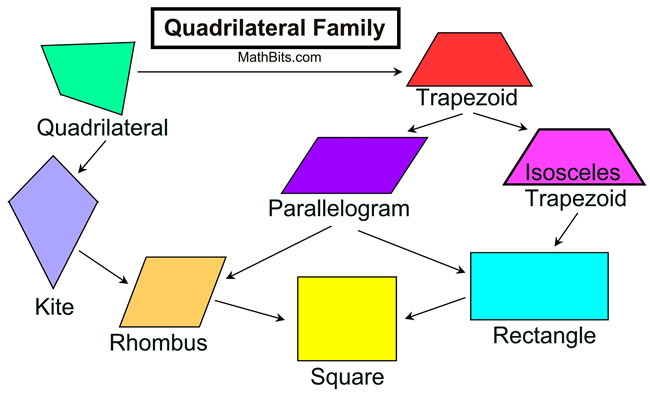


4
III. Important Questions
(A) MCQs (1 Mark)
- The sum of interior angles of a quadrilateral is:
(a) 180° (b) 270° (c) 360° (d) 90°
Answer: (c) 360° - A quadrilateral with all sides equal is:
(a) Rectangle (b) Rhombus (c) Trapezium (d) Kite
Answer: (b) Rhombus - A rectangle has:
(a) All sides equal (b) All angles 90° (c) Only one pair parallel (d) None
Answer: (b) All angles 90° - Which quadrilateral has only one pair of parallel sides?
(a) Square (b) Rectangle (c) Trapezium (d) Rhombus
Answer: (c) Trapezium
(B) Short Answer Questions (2/3 Marks)
- Define a quadrilateral with an example.
- State the properties of a parallelogram.
- What is the difference between a square and a rectangle?
- Find the missing angle if three angles of a quadrilateral are 90°, 80°, and 70°.
(C) Long Answer Questions (5 Marks)
- Explain the angle sum property of a quadrilateral with an example.
- Compare properties of square, rectangle, and rhombus.
- Prove that opposite angles of a parallelogram are equal.
- Solve problems based on missing angles in quadrilaterals.
(D) HOTS Questions
- Can a quadrilateral have three right angles? Justify your answer.
- A quadrilateral has angles 90°, 90°, 90°, and 90°. Identify the quadrilateral and justify.
IV. Key Formulas / Concepts
- Sum of angles = 360°
- Opposite sides of parallelogram are equal
- Diagonals of parallelogram bisect each other
Example:
If three angles are 80°, 90°, 100°, then fourth angle =
360° – (80° + 90° + 100°) = 90°
V. Deleted Portions (CBSE 2025–2026)
No portions have been deleted from this chapter as per the rationalized NCERT textbooks.
VI. Chapter-Wise Marks Bifurcation (Estimated – CBSE 2025–2026)
| Unit/Chapter | Estimated Marks | Type of Questions Typically Asked |
|---|---|---|
| Quadrilaterals | 5–7 Marks | MCQs, Short Answer, Diagram-based |
Note: This is an estimate. Actual marks distribution may vary.
VII. Previous Year Questions (PYQs)
1 Mark
- What is the sum of angles of a quadrilateral? (CBSE 2020)
2/3 Marks
- Find the unknown angle in a quadrilateral. (CBSE 2019)
5 Marks
- Explain properties of parallelogram with diagram. (CBSE 2018)
VIII. Real-World Application Examples
- Architecture: Windows, doors, and tiles are quadrilateral shapes.
- Engineering: Bridge designs use parallelogram structures.
- Daily Objects: Books, screens, tables are rectangular.
- Design & Art: Patterns and layouts use quadrilateral shapes.
IX. Student Tips & Strategies for Success
Time Management
- Practice diagrams regularly.
- Revise properties daily.
Exam Preparation
- Learn properties of each quadrilateral.
- Practice angle-based problems.
Stress Management
- Use diagrams to visualize concepts.
- Break problems into smaller steps.
X. Career Guidance & Exploration (Class 8 Level)
- Important for:
- Architecture & Design
- Civil Engineering
- Graphic Designing
- Builds spatial and logical thinking skills.
XI. Important Notes
- Draw neat and labeled diagrams in exams.
- Focus on understanding properties.
- Practice numerical problems regularly.
- Refer to CBSE updates for latest syllabus.