



Report a question

Class 8 → Mathematics → Chapter 5: Number Play (New Course)
I. Chapter Summary
This chapter explores the interesting patterns and properties of numbers, making mathematics fun and engaging. Students learn about factors, multiples, divisibility rules, prime and composite numbers, and number tricks. The chapter also introduces concepts like LCM (Least Common Multiple), HCF (Highest Common Factor), and their applications. Through patterns and logical reasoning, students develop strong number sense and problem-solving skills.
II. Key Concepts Covered
1. Factors and Multiples
- Factors: Numbers that divide another number exactly
- Example: Factors of 12 → 1, 2, 3, 4, 6, 12
- Multiples: Numbers obtained by multiplying a number
- Example: Multiples of 5 → 5, 10, 15, 20…
2. Prime and Composite Numbers
- Prime Numbers: Numbers with only two factors (1 and itself)
- Example: 2, 3, 5, 7
- Composite Numbers: Numbers with more than two factors
3. Divisibility Rules
- Divisible by 2 → Last digit even
- Divisible by 3 → Sum of digits divisible by 3
- Divisible by 5 → Ends with 0 or 5
4. HCF (Highest Common Factor)
- Largest number that divides two or more numbers
5. LCM (Least Common Multiple)
- Smallest number divisible by two or more numbers
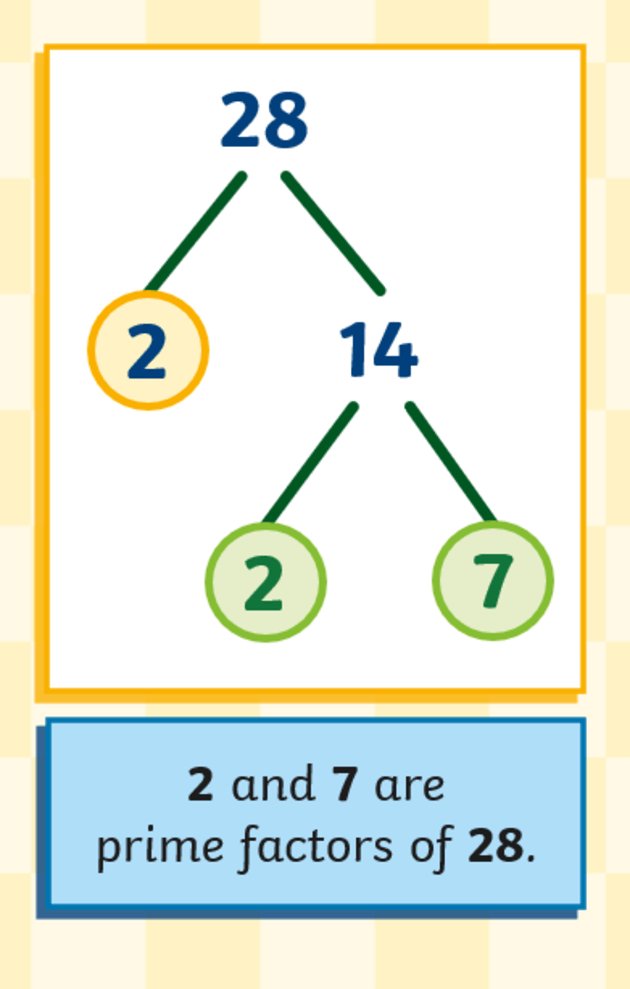
6. Prime Factorization
- Expressing a number as a product of prime numbers
- Example: $24 = 2 \times 2 \times 2 \times 3$
7. Number Patterns
- Even–Odd patterns
- Multiplication patterns
- Number tricks and puzzles
Visual Understanding of Number Concepts
III. Important Questions
(A) MCQs (1 Mark)
- Which of the following is a prime number?
(a) 9 (b) 15 (c) 7 (d) 21
Answer: (c) 7 - The HCF of 12 and 18 is:
(a) 2 (b) 3 (c) 6 (d) 9
Answer: (c) 6 - Which number is divisible by 5?
(a) 42 (b) 55 (c) 63 (d) 48
Answer: (b) 55 - The LCM of 4 and 6 is:
(a) 10 (b) 12 (c) 24 (d) 6
Answer: (b) 12
(B) Short Answer Questions (2/3 Marks)
- Find the factors of 20.
- Write the first five multiples of 7.
- Check whether 29 is a prime number.
- Find the HCF of 16 and 24.
(C) Long Answer Questions (5 Marks)
- Explain prime factorization with an example.
- Find the LCM of 12, 15, and 20 using prime factorization.
- Explain divisibility rules with examples.
- Solve problems involving HCF and LCM.
(D) HOTS Questions
- Find the smallest number divisible by both 6 and 8. Explain your method.
- A number leaves remainder 2 when divided by 5. What could be the number? Explain.
IV. Key Formulas / Concepts
- HCF → Greatest common divisor
- LCM → Least common multiple
- Prime Factorization → Breaking into prime factors
Example:
- $18 = 2 \times 3 \times 3$
- HCF of 18 and 24 = 6
- LCM of 18 and 24 = 72
V. Deleted Portions (CBSE 2025–2026)
No portions have been deleted from this chapter as per the rationalized NCERT textbooks.
VI. Chapter-Wise Marks Bifurcation (Estimated – CBSE 2025–2026)
| Unit/Chapter | Estimated Marks | Type of Questions Typically Asked |
|---|---|---|
| Number Play | 5–7 Marks | MCQs, Short Answer, Application-based |
Note: This is an estimate. Actual marks distribution may vary.
VII. Previous Year Questions (PYQs)
1 Mark
- Identify a prime number from given options. (CBSE 2020)
2/3 Marks
- Find HCF of two numbers. (CBSE 2019)
5 Marks
- Solve problems using LCM and HCF. (CBSE 2018)
VIII. Real-World Application Examples
- Timetables: LCM helps in finding common intervals.
- Grouping: HCF helps in equal distribution.
- Shopping: Divisibility helps in calculations.
- Coding & Cryptography: Prime numbers are widely used.
IX. Student Tips & Strategies for Success
Time Management
- Practice factorization daily.
- Revise divisibility rules.
Exam Preparation
- Learn prime numbers up to 50.
- Practice LCM and HCF problems.
Stress Management
- Solve puzzles to make learning fun.
- Stay consistent with practice.
X. Career Guidance & Exploration (Class 8 Level)
- Important for:
- Mathematics & Statistics
- Computer Science
- Finance & Banking
- Builds logical reasoning and analytical thinking.
XI. Important Notes
- Practice prime factorization regularly.
- Learn divisibility rules thoroughly.
- Focus on understanding concepts, not memorizing.
- Refer to NCERT and CBSE updates.